
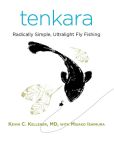
I just finished reading what might be considered the seminal
introduction to Tenkara in the United States .
Published in 2011, a short time after Tenkara was brought to the US
the author Dr. Kevin Kelleher and his consultant Misako Ishimura wrote a
wonderful little tome about Tenkara.
This is not just a book for the beginner but also the
seasoned Tenkara angler. Upon first reading the book cover to cover I learned many
interesting little tidbits of information that spawned an ever growing need for
more data on Tenkara.
For the beginning angler the book gives a few chapters to
start understanding a bit more about Tenkara and its history. The first chapter
gives a very nice overview of what Tenkara is and how it developed in Japan .
The author gives a few brief allusions to the traditional Japanese Tenkara fly;
the kebari. We move on to the simplicity of the equipment needed to start out
as a Tenkara angler. Dr. Kelleher describes the basics of what is needed along
with a few notes on stuff that might be nice to have yet always focuses on the
aspect of simplicity which is central to traditional Tenkara. Interestingly, he
also includes a brief description of how to remove an embedded hook from your
flesh if you have the unfortunate experience of sinking a hook firmly into a
finger. (I know at least a few of us may have or will do this at some point in
our fishing careers!)
Once Dr. Kelleher finishes letting you know the necessary
accoutrements to get started, he goes into a wonderful little discourse on
rigging your Tenkara rod to set up for your first casting foray or tromp to the
river. All the common knots are covered in detail with very clear drawings to
look at if you are not really sure what to do. I advise you to follow his
suggestion to practice a few of the knots so that when you do get out there you
are confident in your knots.
Dr. Kelleher gives you a neat little introduction into
fishing a dry fly using a Tenkara rod. From there, he goes into the theory of
Wabi-Sabi that even a newbie such as me can understand. You will find a few
chapters on types of water and what to look for when you get to the river or
even a large body of water such as a lake. These chapters come in handy for the
new angler but may help the more experienced angler to sharpen his eyes when
out on whatever size body of water that may be chosen-- be it a small stream, a
large river, or a lake.
The reader will find concise writing on the casts common to
Tenkara as well as a brief lesson in how to land a fish either by hand or using
a net. The description of how to land a fish with as little damage to the fish
is refreshing to see in any fly fishing book. The respect that the author has
for the fish is something all anglers need to remember.
Once you have read the book up to this point, I can
guarantee that you will be chomping at the bit to get out on the water and try
everything you have read, but I suggest you just go a little bit further.
The author goes into the bugs commonly found in many rivers
and lakes that every fish will eat if it has access to the form of bug life in
its environment. There are pictures of both the nymphal stages as well as the
bug as a grown adult. It is not an exhaustive education in entomology, but well
drawn pictures should give you a basic understanding of what you will see on or
in the water.
Interestingly, the next chapter is about the flies that an
angler might use. After a quick description of how to tie your first fly, the
book goes into flies that are commonly used in different parts of the United
States . Those flies are what would be
considered Western flies such as the Royal Wulff, or Elk Hair Caddis. There is
a bow to traditional Tenkara when the book details the Tenkara kebari and the
“One Fly” theory that Dr. Ishigaki, (who is considered by many to be a true
Tenkara master,) uses when he is fishing. The biggest thing to take from this
chapter, as well as the other chapters in the book is to keep it simple! Don’t
confuse yourself with extraneous stuff that only bogs you down.
Deeper into the book the author gets into more detailed
aspects of Tenkara that may seem overwhelming for a beginner but at the same
time lets the readers see that there are aspects that will last a lifetime when
it comes to learning. The book teaches how to build a furled line as well as a
few tapered level lines. If you like to be an experimenter, this is a great
chapter to read.
And lest we forget, there is some great information on how
Tenkara is inherently designed for the new ultralight backpacking movement that
is sweeping the nation. Ideas are given on how to carry a Tenkara rod while
hiking into the backcountry. There are some great hints on gear that will allow
you to fish, yet keep your load light. One thing I did find that maybe didn’t
make me feel totally comfortable, but might be viable in some environments was
the author’s suggestions on how to cook a trout using different recipes. The
author does state that he only cooks a trout if the environment would support
this but also makes sure to gently push the “catch and release” ethic commonly
found throughout fly fishing.
To close out the book, there is a wonderful description of how
Tenkara seems to fit women so well. The ease of casting, a woman’s innate sense
of rhythm, and her gentle mind set (at least in some women-LOL!). The book does
not forget about introducing children to Tenkara as a gateway into fly fishing.
The reader is reminded that this is supposed to be fun and a learning
experience for all involved. So take what you can and play with it and enjoy.
The book then closes with, what in my opinion is an almost
poetic description of what Tenkara is and what it can become for the reader and
Tenkara practitioner.
I hope that this will help you to explore Tenkara a little
more and I hope you find even more than maybe I did.
I want to close by thanking both Dr. Kelleher and Misako
Ishimura for putting time and effort into creating this volume so that those
who are just coming to Tenkara have a handy resource on their bookshelves.
